Web Applications
A reading order for a comic run nobody has indexed
Built by Odette Nuqui
A long-running comic series with three hundred-odd issues, four renumberings and several side series, arranged into an order you can actually read it in.
Builder email verified
Verification
- Type
- Personal
- Category
- Web Applications
- Published
- Jul 26, 2026
- Updated
- Jul 26, 2026
About this project
- What I built & why
I got into a comic series in 2023 that has been running since the eighties, and discovered that the question "where do I start" has no answer anywhere that is not a forum thread from 2016 with half its links dead. The series renumbered four times, has two side series that matter and three that do not, and a stretch in the middle where the story is told out of publication order on purpose. I spent about a month working it out from a spreadsheet and then realised the spreadsheet was more valuable than the reading. So I turned it into a site, mostly because I was annoyed that I had to do this at all.
- The problem
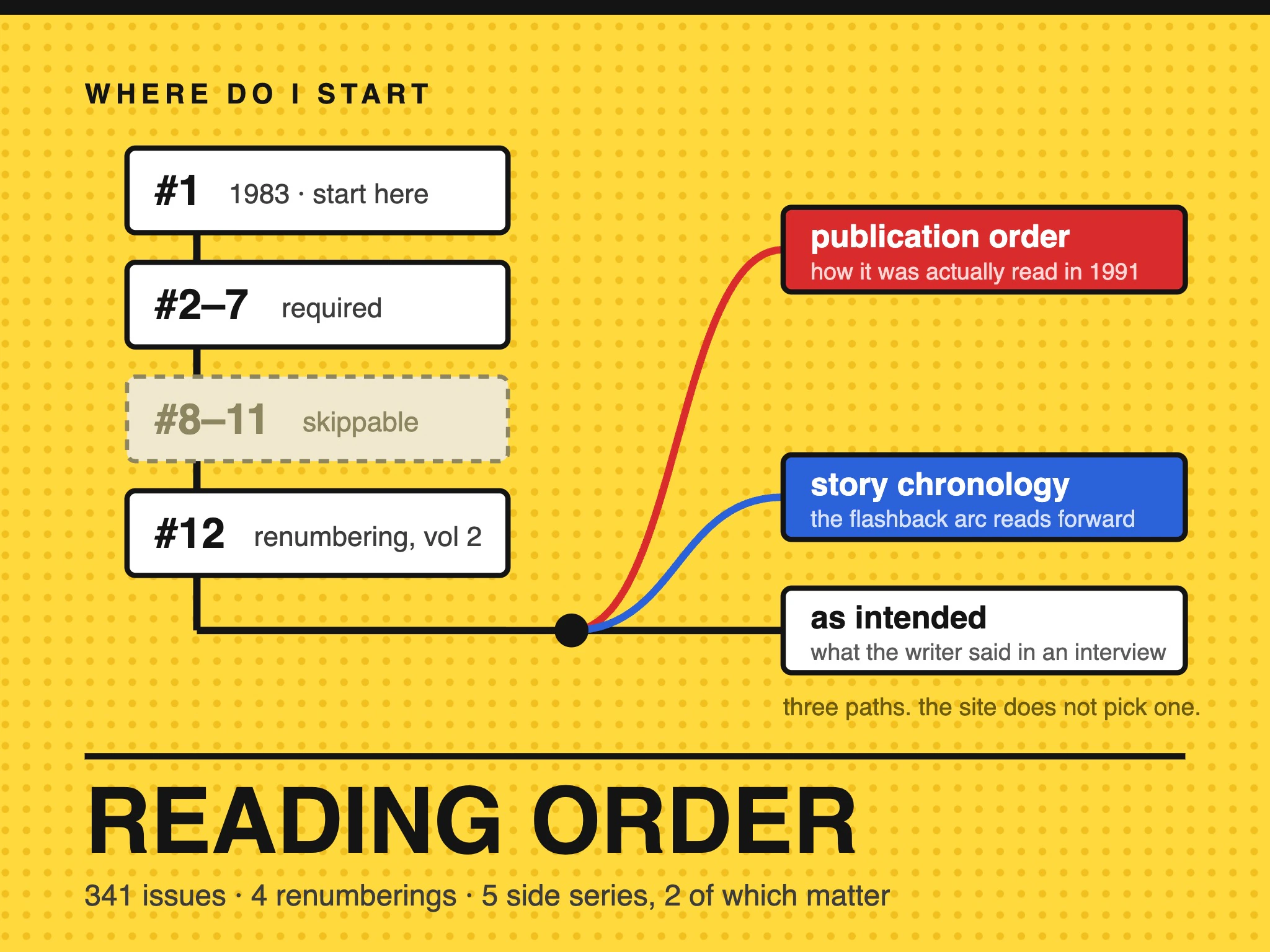
It is for people who want to read a long series and cannot find the door. It holds every issue with its publication data, its position in the story, and short spoiler-free notes about whether it is required, optional or safely skippable, and then generates a reading order for the path you pick — the whole thing, the main line only, or one particular character's arc. The notes are the actual work and the actual value; the ordering is a topological sort over data I entered by hand. It marks where the out-of-order stretch begins and explains why, which is the point at which most people give up.
- What I owned
All of it, including entering the data for three hundred and forty issues over about six weeks, which is the least interesting and most necessary part. I built the ordering, the path selection, and the progress tracking that remembers where you are without an account, in the browser. I wrote every note myself, which required reading or re-reading a great deal of it, and I keep them spoiler-free by writing them at the level of whether an issue matters rather than what happens in it. The design is deliberately plain because I am not a designer and I know what happens when I try.
- Technical & product decisions
I chose to make it static — the data is a set of files in the repository and the site is generated on build — because I wanted it to still be up in ten years without me paying for or patching anything. That rules out user accounts and community contributions, which several people have asked for, and I have decided that trade is right for a project I do alone. I also decided against a comments section on each issue, which would double the value and would also mean moderating spoilers forever. Corrections come in as pull requests or emails, and there have been about sixty, roughly a third of which were right.
- Hardest challenge
The hard part turned out to be the out-of-order stretch, because there is no single correct answer — the publication order, the in-story chronology and the order the writer has said he intended are three different things, and enthusiasts argue about it with some feeling. My first version picked one and presented it as the order, and I got a lot of email. What it does now is present all three as named paths with a short explanation of what each optimises for, and stays out of the argument. That was a lesson about the difference between having an opinion and shipping one.
- Result & impact
It has been up since 2024 and gets somewhere around four thousand visits a month, which for a niche of a niche I find surprising. About sixty corrections from readers, some of them from people who clearly know the series far better than I do, and one from someone who worked on it. Two people have emailed to say they finished the whole run using it, which is a slightly absurd thing to be proud of. Total cost to run is nothing, which was the design goal.
- Who else worked on it
A reader who has followed the series since it started rewrote about forty of my notes for the middle period, where my summaries were confidently wrong, and now reviews new notes before I publish them.