Games
House Rules
Built by Randolf Agbayani
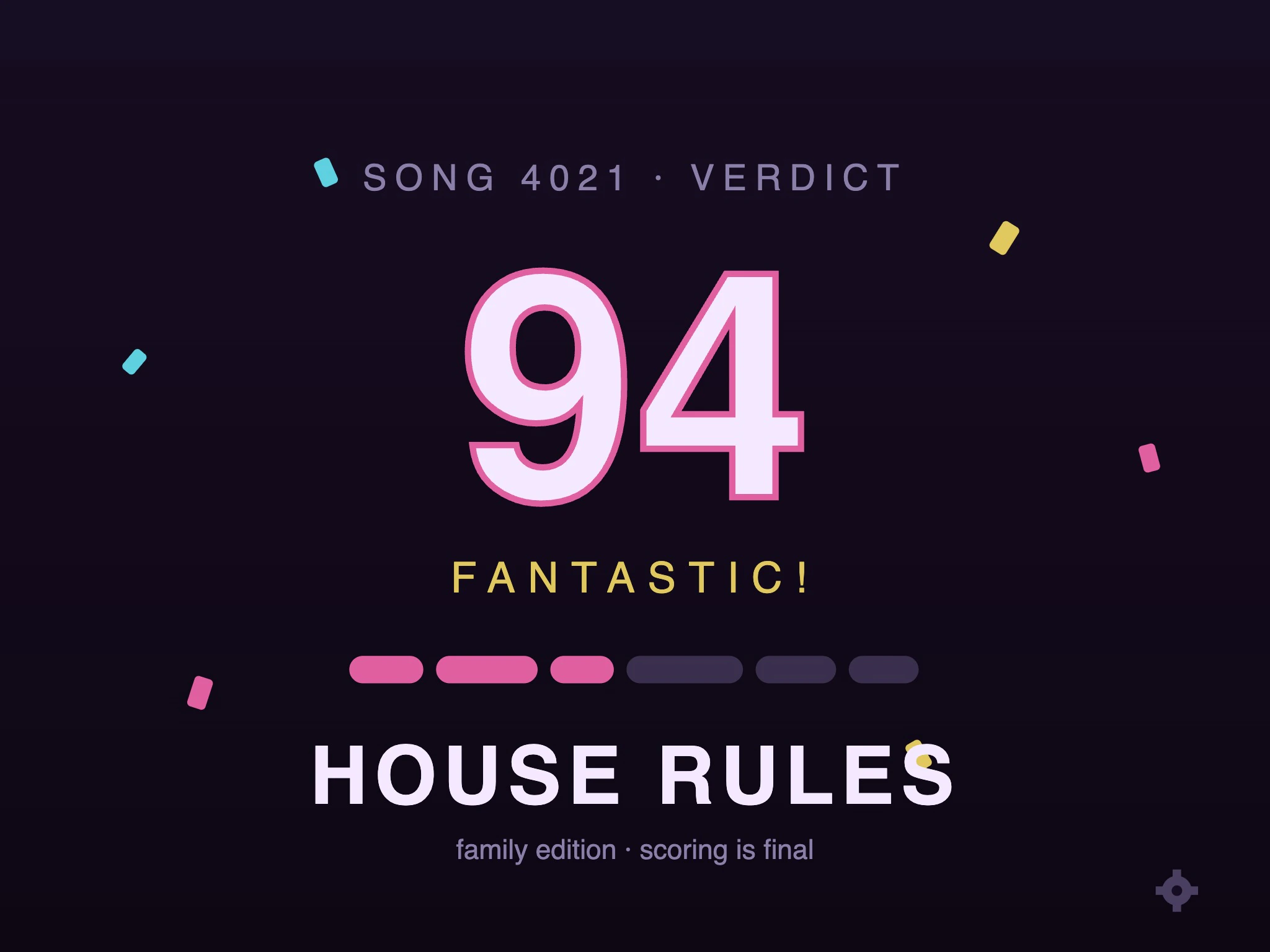
A karaoke scoring app for family parties with a configuration file that guarantees my mother-in-law has never scored below ninety.
Builder email verified
Verification
- Type
- Personal
- Category
- Games
- Published
- Jul 26, 2026
- Updated
- Jul 26, 2026
About this project
- What I built & why
Our family videoke machine assigned scores by what I can only assume was a random number generator with a grudge, and its verdicts caused genuine diplomatic incidents — my mother-in-law once received a 71 for a ballad she has performed at every family gathering since before I joined the family, and the evening did not recover. I test software for a living; I know a scoring system that has lost the trust of its users when I see one. So I built a replacement with the failure mode removed.
- The problem
The problem, formally: score karaoke performances convincingly enough to sustain a competition, while structurally preventing the outcomes that end parties. The users are about fifteen regulars at family gatherings, ranging from my nephew who raps to my father-in-law who performs exclusively in Ilocano, and the deployment environment is a living room television with one wireless microphone and no patience for setup.
- What I owned
All of it: the pitch tracking, the scoring model, the celebration screens, and the configuration file — especially the configuration file. I also operate it at every gathering, which means I am the on-call engineer for my own party trick, a situation my professional life prepared me for exactly.
- Technical & product decisions
The scoring is real: the app tracks pitch against the melody line and scores genuine accuracy, because a scorer that's obviously random gets found out by children within one evening. On top of that sits a per-singer handicap profile, defined in a configuration file rather than any visible interface, so the system's deeper values remain a private matter between me and the JSON. I scored in windows of a few seconds rather than note-by-note alignment after the microphone's latency made per-note comparison a lie, and I made the celebration screen's duration scale with the score, on the data-backed observation that a long celebration produces dancing and dancing produces goodwill toward the scoring system.
- Hardest challenge
The hard technical problem was scoring against the backing track's key when half the family sings a full octave below the original, and my father-in-law transposes by feel into keys of his own discovery. The scorer now folds pitch comparison to the nearest octave and detects a singer's chosen transposition in the first few phrases, which took most of my Christmas break and survives contact with everyone except one uncle, for whom I created a second, more philosophical handicap entry.
- Result & impact
Two years in service across maybe twenty gatherings, and scores from the app are cited in family conversation as objective fact, which is exactly the trust level the old machine squandered. My mother-in-law's documented floor is 91. Nobody has ever asked to see the configuration file — though my wife found it on her own, read it in silence, and requested a single change which I made immediately and will not disclose.