Open Source
Landfall
Built by Rowena Dimaculangan
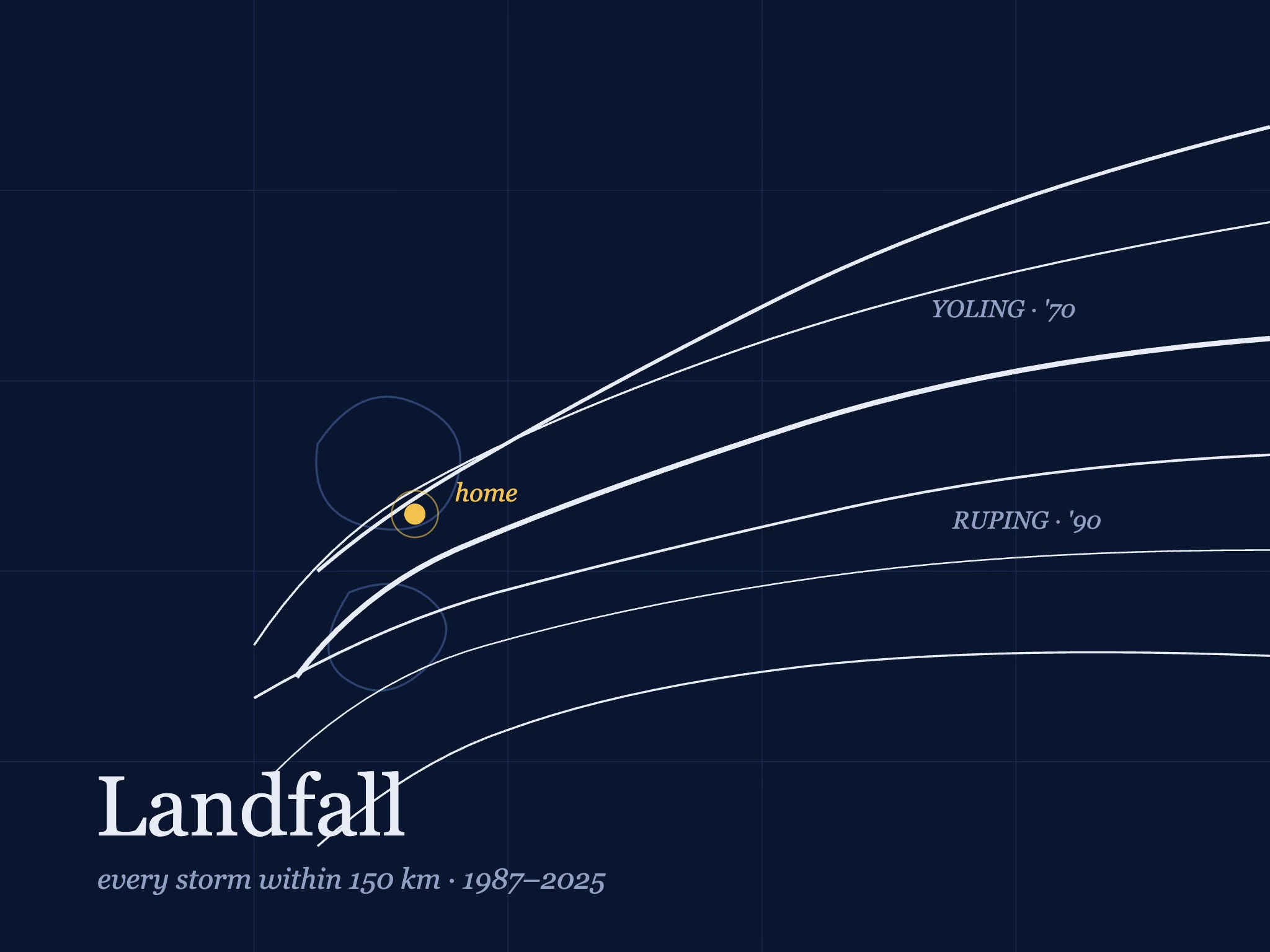
A poster generator that draws every typhoon track that passed within 150 kilometres of my hometown since the year I was born — one line per storm, thirty-eight years of weather on one sheet.
Builder email verified
Verification
- Type
- Personal
- Category
- Open Source
- Published
- Jul 26, 2026
- Updated
- Jul 26, 2026
About this project
- What I built & why
My family, like a lot of families from Eastern Samar, keeps time by storms — events are dated as before or after this typhoon or that one, and everyone knows exactly where they were for the big ones. The tracks all exist in public best-track archives, but as rows of coordinates, which is data, not memory. I wanted to see the family's private calendar drawn as one object: every storm that ever actually came near us, in my lifetime, on a sheet my parents could hang in the sala.
- The problem
Turn a public typhoon best-track archive into a printed poster for one specific town: filter thirty-eight years of Pacific storms down to the ones that passed within 150 kilometres of it, draw each track as a single line across a spare map, and make the sheet legible as an object on a wall rather than a chart in a report. The audience is my parents and their generation — people who will read it by finding storms they remember, not by consulting a legend.
- What I owned
All of it: the data cleaning, the track filtering and projection, the composition and typography, and the printing, which involved more trips to a large-format print shop than I care to invoice myself for. Also the editorial calls — which storms make the sheet, what a line is allowed to look like — which turned out to be the actual work.
- Technical & product decisions
Distance to town, not 'landfall', is the filter — storms that never made landfall but passed close enough to take the roof's edge belong on the family's sheet, and official landfall lists would have excluded two storms my mother considers biographical. Intensity became line weight rather than colour, partly so it prints in one ink, mostly because the poster is about the shape of a life lived under weather, and a red-alert palette would have made it a hazard map. I kept the raw six-hourly track points and their slight angularity instead of smoothing the curves — the kinks are what the data actually said, and smoothing them felt like lying politely. And after the single all-years poster came out as an unreadable nest, it became one poster per decade, four sheets, which the wall accommodates and the eye can actually enter.
- Hardest challenge
The archives fight you: the same storm appears under its international name in one source and its Philippine name in another, with occasional disagreements about position at the same timestamp, and my first pass double-drew a 1990s decade so densely my father asked what was wrong with that one. Deduplicating meant matching storms across archives by time and position rather than by name, then choosing which source's track to trust per storm and writing the choice down. The names on the finished posters are the Philippine ones, because those are the ones anyone in the house has ever spoken.
- Result & impact
Three posters printed, one framed in my parents' sala — the decade with the storm that took the old house's roof, which my mother chose deliberately and I did not question. She then annotated the frame's margin by hand: tiny pencil notes beside certain tracks recording what the family was doing during that one. Relatives who visit find their storms with a finger and start telling stories, every time, without being asked. The annotated copy is the real project now; I just drew the lines under it.
- Who else worked on it
My mother is co-author by annotation, and my father contributed quality assurance by pointing at one track and saying it came through in a different month than I'd labelled — he was right, and the errata took a weekend. The print shop owner, by the third visit, had opinions about paper weight, and they were good opinions, and the posters are on his recommended stock.