Web Applications
A page-imposition tool for a five-person zine group
Built by Pia Verzosa
Five of us make small printed zines on a borrowed duplicator, and I got tired of us assembling pages in the wrong order, so I made the ordering a tool instead of a ritual.
Builder email verified
Verification
- Type
- Personal
- Category
- Web Applications
- Published
- Jul 26, 2026
- Updated
- Jul 26, 2026
About this project
- What I built & why
A folded zine's pages do not print in reading order — page one shares a sheet with the last page, and the arrangement changes with the page count and the fold. We were working this out by hand every time, usually late, usually wrong, and a misordered run on a duplicator is wasted paper and an hour of somebody's evening. I built the first version in a weekend in 2024 after we ruined about sixty sheets on a run of forty copies. It is not a design tool and it does not lay anything out; it takes finished pages and works out which goes where on which side of which sheet.
- The problem
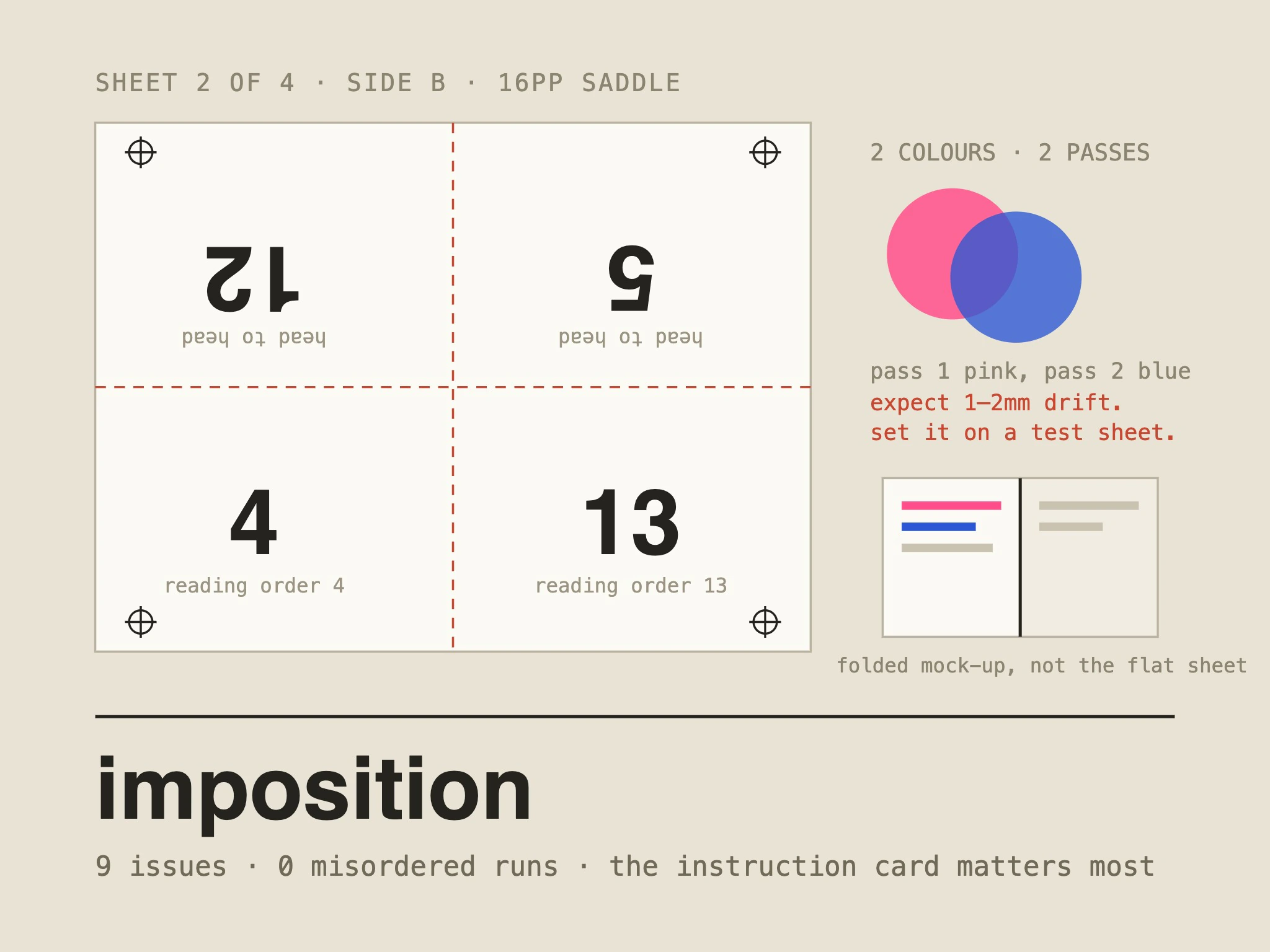
It is for five people and, since we put it on a shared machine, a couple of other small groups who print the same way. You give it your pages in reading order and tell it the fold, the page count and which colours the machine is loaded with, and it produces the imposed sheets ready to send, plus a printed instruction card for the person feeding the machine. The instruction card is the part everyone uses. It also warns when the page count is not a multiple of four, which is the mistake that has cost us the most paper.
- What I owned
All of it, which for me meant learning enough about the actual print process to encode it, mostly by ruining paper. The imposition maths is small once you understand it and completely opaque until you do. The part I put real work into is the two-colour handling: this kind of printing lays one colour at a time, so a page that uses both needs its channels separated and the sheets need to run through twice in a specific order, and the tool produces that sequence with registration marks. I also made the preview show a folded mock-up rather than the flat sheets, because the flat sheets tell you nothing about whether it is right.
- Technical & product decisions
I decided it should output files and a paper instruction card rather than talk to the machine, which several people suggested. The duplicator we borrow is not ours, its driver situation is grim, and the tool would then be tied to one machine in one room — whereas a PDF and a card work anywhere, including at the copy shop we use when the duplicator is unavailable. I also chose to accept only finished page images rather than any editable format, which keeps the tool at about a tenth of the size it would otherwise be and means it will never become a layout program, which is a thing I have to stop myself doing.
- Hardest challenge
Getting registration right for the two-colour runs took me four attempts across about three months. Paper stretches slightly on the first pass, so the second colour lands a fraction off, and no amount of correct maths in the file fixes a physical property of the paper. What works is putting registration marks in the trim area and a deliberate small adjustment the operator can set per run after a test sheet, which is exactly how real print shops do it and which I arrived at from first principles by wasting a lot of paper. I also learned that a preview showing perfect registration teaches people to expect it, so the preview now shows a slight offset.
- Result & impact
Nine issues since 2024 with no misordered run, against roughly one ruined run in three before. The instruction card removed the single point of failure where one of us knew how to feed the machine and the others did not. Two other small groups use it, one of which sent me a fix for a fold type we do not use. It has stayed small — about a thousand lines — which I am more pleased about than I probably should be.
- Who else worked on it
One of the five is an actual printer by trade and told me what registration marks are for after watching me try to solve it in software. Another designed the instruction card, which is the most-used output of the whole thing and looks considerably better than my version.